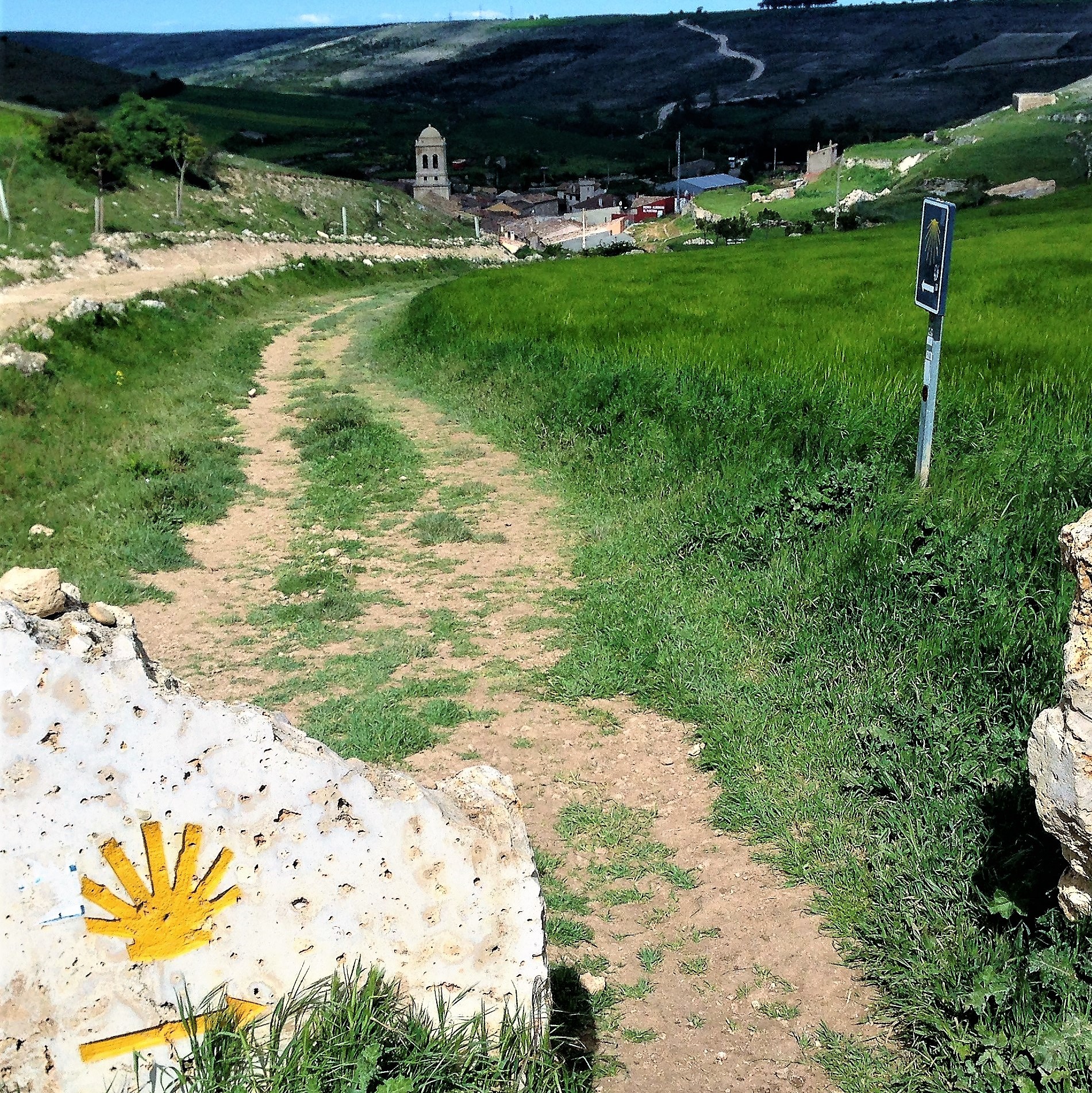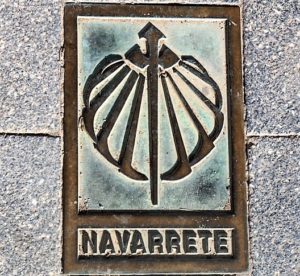
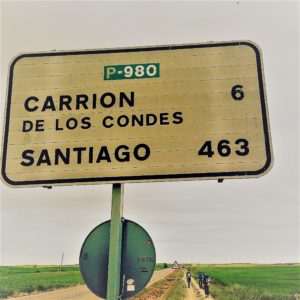
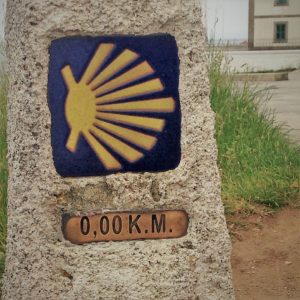
 The little yellow arrow is always there pointing the way forward. But it never answers the question – are we there yet?? Pilgrims need not worry. Distance markers are a constant presence along the camino, placed to remind you that there are still many miles to go before you sleep (apologies to Robert Frost). You begin in Roncesvalles, where the sign tells you only 790 km. left, pass the plaque in Sahagún announcing your arrival at the center of the Camino (400 km. left to go) and finally, if you venture further, to the final stone marker in Finisterre (0.00 km). These signposts are strangely comforting… they assure the pilgrim that they are making progress, the wandering is not aimless. And when all those kilometers are finished, you can start dreaming about the day when you return to the camino and begin your own personal journey again.
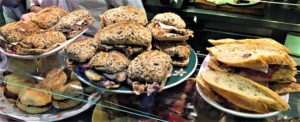
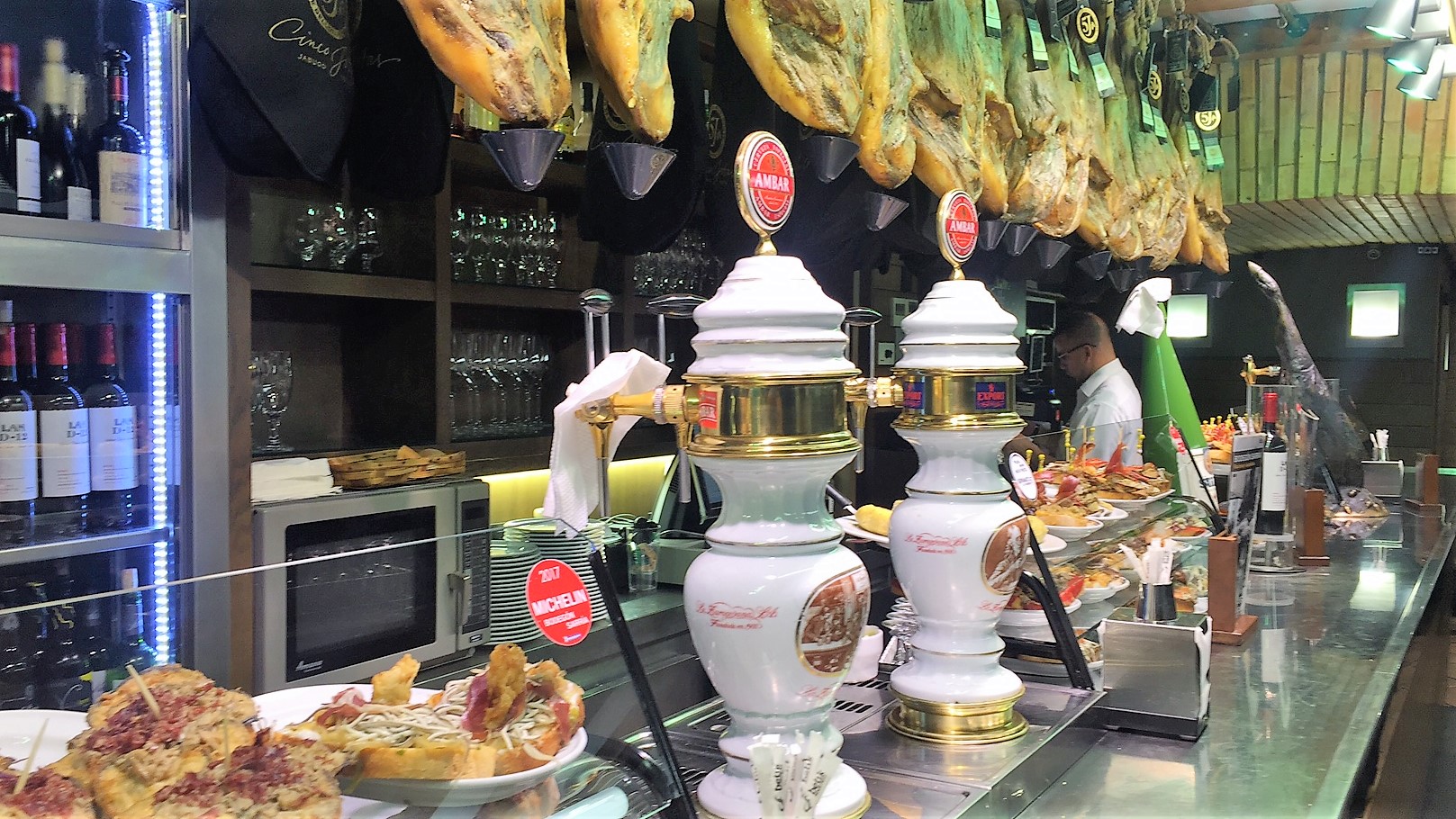
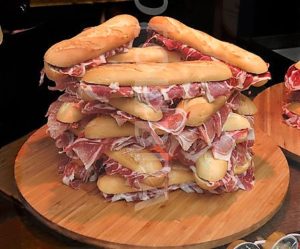 Walking for 20 km. through the Spanish countryside can build a healthy appetite. But, stopping for a real sit-down lunch is not always desirable or practical. Luckily, there is a ready-made solution to the problem of what to eat while trekking along the camino…. sandwiches Spanish-style! A «bocadillo» is a favorite transportable meal usually consisting of a 6-8in. «barra» (baguette), sliced lengthwise down the middle. These are often stuffed with a choice of either ham, cold cuts (embutidos), chorizo, cheese, or tuna. Don’t look to see lettuce, mustard, or mayo here. Maybe, a little rubbed tomato on the cut bread. No other meal has fueled as many pilgrim kilometers as the breakfast bocadillo jammed with «tortilla«, the national omelet of potatoes, eggs and onions. Whichever way you prefer to have it, this portable meal will be one of your best camino friends.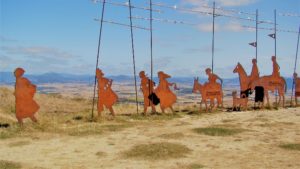
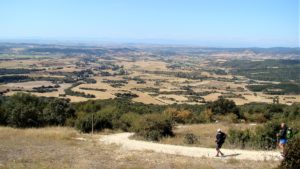 After departing Pamplona, you walk through suburban towns and villages before entering the Navarran countryside. Always in front of you is the heights of the Alto de Perdon, crowned with 21st century windmills. A long, steady climb brings you to the top with its magnificent 360° views. It is here that one of the most famous symbols of the Camino is found. Erected in 1996, the steel figures of pilgrims on foot and horseback were the vision of artist Vincent Galbete. On one of the steeds is the inscription «donde se cruza el camino del viento con el de las estrellas«. (where the path of the wind crosses the path of the stars). After reading such a romantic thought, it’s time to begin the steep journey downward to Puente la Reina.
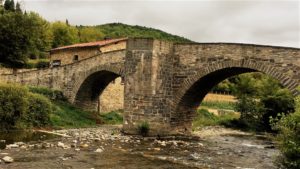 After Roncesvalles, the pilgrim walks through the lower Navarre valleys at the foothills of the Pyrenees. Of the many rivers that flow out of the mountains, the Río Arga will continue along your camino path past Pamplona and through to Puente la Reina before continuing on to meet the mighty Río Ebro as it journeys to the Mediterranean. It is in Zubiri (stopping point stage 2) that the river is spanned by a medieval bridge dating from the 12th century. According to the legend, any animal who passed under the arches of the bridge or around the central pillar would be protected (or cured) of rabies. Today, it is known as the «Puente de la Rabia» (bridge of rabies). While it may not cure any disease, it is a great tonic to stop and refresh your feet in the gentle waters that flow beneath the arches.

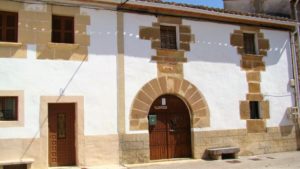
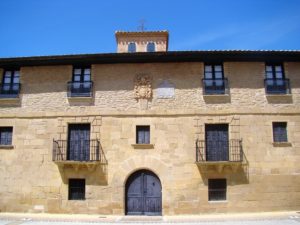 After climbing the Alto de Perdón past Pamplona, the pilgrim sees the vast Valdizarbe below them. Like pearls on a necklace, the towns of Uterga, Legarda, Muruzábal and Óbanos stretch forward in the distance to Puente la Reina, the stopping point of Stage 4. Strong, solid houses are typical of the Navarran style as you pass through these villages. Stone foundations make the base of the ground floor level. These large stones also frame the arched doorways and cornices at the edge of the building. The second floor can be brick or rendered. The upper floor displays small windows tucked up under the eaves. Red-tiled roofs with wooden eaves complete the structure. There is a definite symmetry to the facade with center arched doorways and neatly arranged second floor windows (often with wrought iron balconies). Then topped by small cutouts on the third floor. The colors are earthy tans, browns and rust shades in keeping with the landscape. They present a prosperous appearance, reflecting the comparative wealth of this part of the camino.
 It’s not necessarily shared rooms on the Camino every night. A little luxury can be a great tonic. The Posadas del Camino was created in 2007 for the purpose of bringing together, under a common seal of quality, the most prestigious and best-rated Hotels, Inns and other types of accommodation along the Camino Francés. They offer a welcome place to lay your head after a long day on the road in varied places like Carrion de los Condes or O Cebreiro, Galicia. As well, these country inns and city hotels strive to promote the history, art, nature and rich cuisine of their own region. Just an added touch of comfort. Think of it as one more opportunity to «Experience The Way». After visiting its magnificent Gothic cathedral, you could relax in the casco antiguo (old town) in Léon at member hotel La Posada Regia.