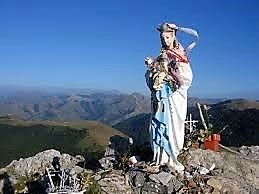
 They say that your hardest day on the Camino will be your first. Climbing the Pyrenees towards Roncesvalles from Saint-Jean-Pied-du-Port will test your endurance right out of the gate. If you take the Route de Napoléon straight over the top, you will pass the Virgén de Biakorri at the Pic d’Orisson. Perched on a rocky outcrop and backed by a magnificent view over the surrounding mountains, she acts as protectress of the shepherds herding their flocks through these pastures. You will see this image of Mary and the infant Jesus countless times along your Camino. If by necessity (weather) or desire, taking the lower route through Valcarlos will bring you, after a short step climb, to the Puerto Ibañeta. Here stands the monument to Roland (monumento de Roldán). This stone commemorates an ancient battle where Roland fell fighting the Saracen army before Charlemagne could arrive. This was in the year 778 A.D. One more reminder that your passage is but one more in a long line of travellers.
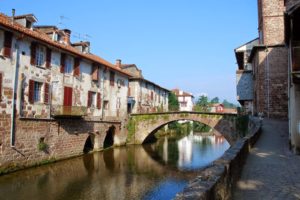
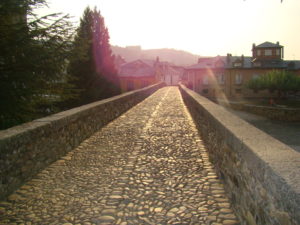
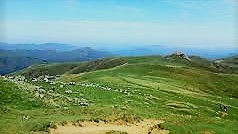 A journey of 800 km. begins with the first step. Crossing the Pilgrim’s bridge over the River Nive at Saint-Jean-Pied-du-Port to begin the climb over the Pyrenees and start the Camino de Santiago. There will be a lot of uphill and then a lot of downhill crossing over the Pyrenees. Don’t rush it, the knees and feet have to last another 775 km.
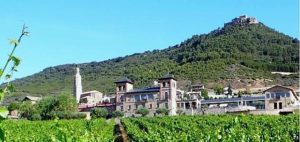 Pamplona is the first major city the pilgrim reaches after de
 scending from the Pyrenees. It is also the largest city along the Camino Francés and the historic capital of the ancient kingdom of Navarra. Over 90% of the wine production of Navarra is red. The main grape variety is tempranillo, but other types such as garnacha and cabernet sauvignon are prominent. Among the whites are chardonnay, malvasia and viura.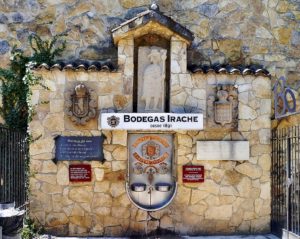
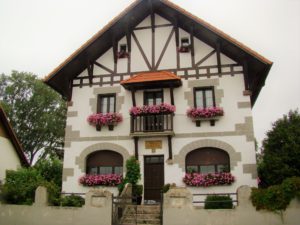 Like all the other sights along the Camino Francés, the housing styles reflect the history, geography and climate the pilgrim will encounter along the route. The climate of northern Spain can run from the searing heat of the meseta to the misty lands of Galicia (known locally as España verde or green Spain). Building materials reveal what was available in the immediate neighbourhood. The lack of stone meant mud-brick adobe in the meseta of Castile-Léon, the abundance of stone in Galicia was the foundation of the traditional palloza (an ancient stone round house with thatched roof). The houses of the Basque country in the Pyrenees were built to withstand the cold winter winds and snow while the buildings in the great plain were designed to hide their occupants from the heat of the midday sun. Some styles are simple in their embrace of the unadorned, massive stone lintels and cornices (in the Navarran countryside) or extravagantly painted in ice cream colours and filigreed ironwork balconies like those of Léon. And wherever you go along the Camino, the beauty of the summer flower boxes spilling over the balcony edge are a delight to the eye. In future posts we will take a look at those houses and what they say about the places in which they were erected and the people who call them home.

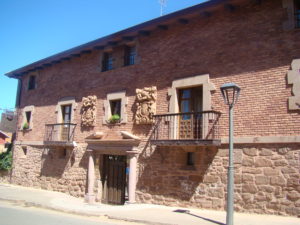 Most pilgrims will spend at least several nights in the company of their fellow walkers in a local albergue. These places form the backbone of the Camino experience. Some are very rustic (the albergue at Manjarín), delightfully eccentric (Albergue parroquial San Juan Bautista in Grañon), religious (Albergue del Monasterio de Samos) or beautifully restored in an historic building (Albergue de peregrinos in Roncesvalles). For many, it is the essence of their Camino. As the popularity of the route blossomed, alternatives to a night in the dormitory appeared. Now, in addition to an albergue stay, the modern pilgrim can enjoy a night in a less communal space. Private rooms, hot showers with clean sheets and towels help ease the stress of a long day on the road.


 Man has always needed to celebrate and commemorate important people and events. The pilgrim’s passage on the Camino de Santiago is no different. Along the 800 km. route, cities, towns and villages as well as individuals have erected or placed statues, memorials and monuments to the arduous trek made so many people. These posts will acknowledge their presence and the impact played by the Camino as it wound its way across the Spanish countryside.